1 / 3
Victorian Nécessaire de Voyage
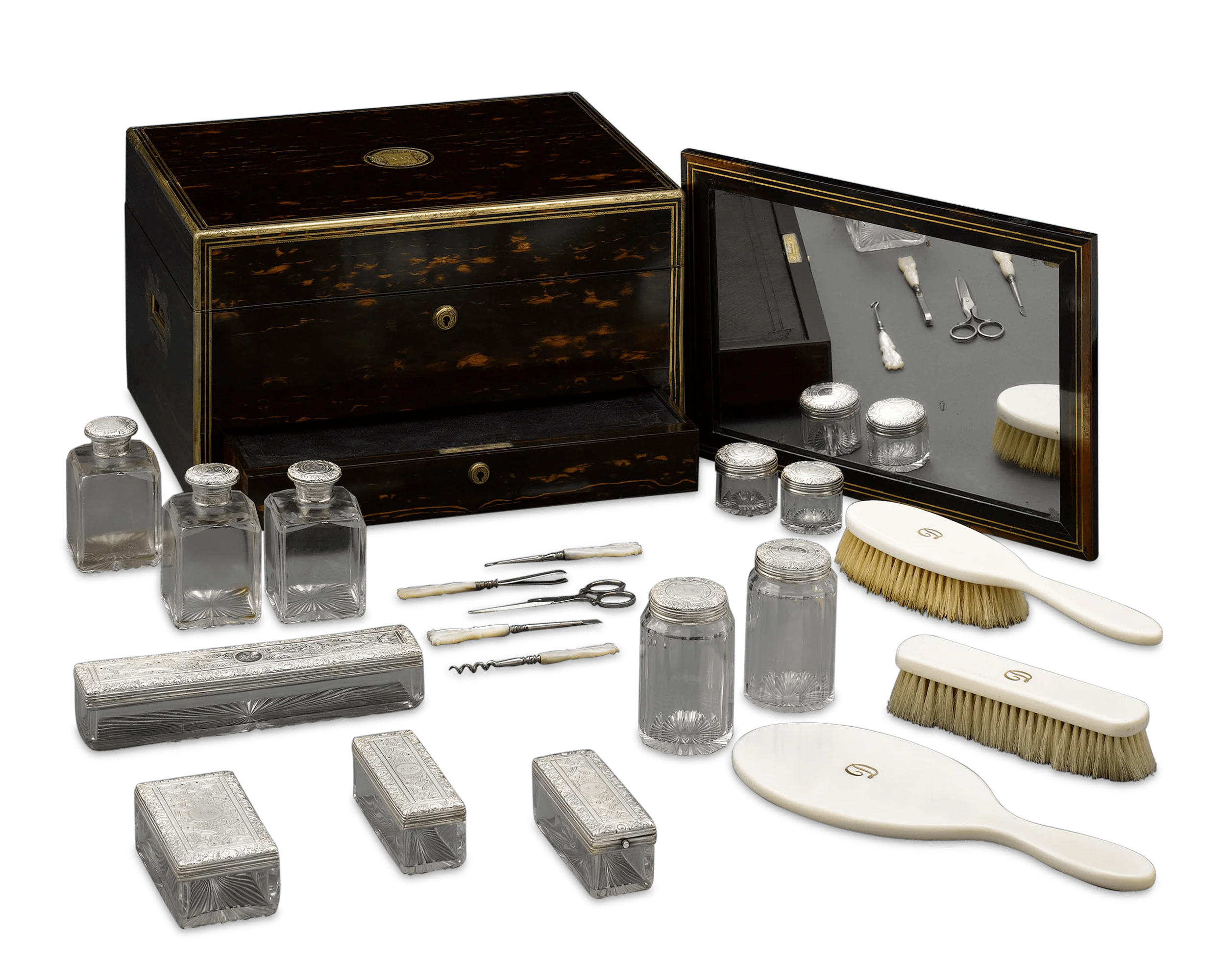
A wonderful English coromandel travel case, or nécessaire de voyage, boasts toiletries adorned with Victorian silver, cut crystal and mother of pearl. The case also contains a lower compartment perfect for storing precious valuables securely during travel. The interior lid is fitted with a stand-alone mirror, behind which important documents can be concealed. Desirable Bramah locks secure the entire nécessaire.
The silver lids bear the monogram of the nécessaire’s original owner, Annie Gilroy, neé Bowman (1844-1855), wife of Alexander Gilroy. The case was given to her by May Gilroy, hence passed on by Annie to her son, Alexander Gilroy.
Travel became a key pastime for the affluent beginning in the 18th century. Young gentlemen and women of high social standing often traveled throughout the Continent in an extended, educational tour known as their Grand Tour. These lengthy journeys required a convenient means of transporting the personal belongings, or necessities, of daily life. Often constructed of luxurious materials such as silver, gold, mother of pearl, crystal, fine woods and leathers, these nécessaries de voyage became highly personalized symbols of wealth and taste, carrying everything from toiletries and jewelry to sewing and writing instruments.
Circa 1865
14” wide x 10 1/4” deep x 7 3/4” high
The silver lids bear the monogram of the nécessaire’s original owner, Annie Gilroy, neé Bowman (1844-1855), wife of Alexander Gilroy. The case was given to her by May Gilroy, hence passed on by Annie to her son, Alexander Gilroy.
Travel became a key pastime for the affluent beginning in the 18th century. Young gentlemen and women of high social standing often traveled throughout the Continent in an extended, educational tour known as their Grand Tour. These lengthy journeys required a convenient means of transporting the personal belongings, or necessities, of daily life. Often constructed of luxurious materials such as silver, gold, mother of pearl, crystal, fine woods and leathers, these nécessaries de voyage became highly personalized symbols of wealth and taste, carrying everything from toiletries and jewelry to sewing and writing instruments.
Circa 1865
14” wide x 10 1/4” deep x 7 3/4” high
A wonderful English coromandel travel case, or nécessaire de voyage, boasts toiletries adorned with Victorian silver, cut crystal and mother of pearl. The case also contains a lower compartment perfect for storing precious valuables securely during travel. The interior lid is fitted with a stand-alone mirror, behind which important documents can be concealed. Desirable Bramah locks secure the entire nécessaire.
The silver lids bear the monogram of the nécessaire’s original owner, Annie Gilroy, neé Bowman (1844-1855), wife of Alexander Gilroy. The case was given to her by May Gilroy, hence passed on by Annie to her son, Alexander Gilroy.
Travel became a key pastime for the affluent beginning in the 18th century. Young gentlemen and women of high social standing often traveled throughout the Continent in an extended, educational tour known as their Grand Tour. These lengthy journeys required a convenient means of transporting the personal belongings, or necessities, of daily life. Often constructed of luxurious materials such as silver, gold, mother of pearl, crystal, fine woods and leathers, these nécessaries de voyage became highly personalized symbols of wealth and taste, carrying everything from toiletries and jewelry to sewing and writing instruments.
Circa 1865
14” wide x 10 1/4” deep x 7 3/4” high
The silver lids bear the monogram of the nécessaire’s original owner, Annie Gilroy, neé Bowman (1844-1855), wife of Alexander Gilroy. The case was given to her by May Gilroy, hence passed on by Annie to her son, Alexander Gilroy.
Travel became a key pastime for the affluent beginning in the 18th century. Young gentlemen and women of high social standing often traveled throughout the Continent in an extended, educational tour known as their Grand Tour. These lengthy journeys required a convenient means of transporting the personal belongings, or necessities, of daily life. Often constructed of luxurious materials such as silver, gold, mother of pearl, crystal, fine woods and leathers, these nécessaries de voyage became highly personalized symbols of wealth and taste, carrying everything from toiletries and jewelry to sewing and writing instruments.
Circa 1865
14” wide x 10 1/4” deep x 7 3/4” high
$4,350.00
Original: $14,500.00
-70%Victorian Nécessaire de Voyage—
$14,500.00
$4,350.00Description
A wonderful English coromandel travel case, or nécessaire de voyage, boasts toiletries adorned with Victorian silver, cut crystal and mother of pearl. The case also contains a lower compartment perfect for storing precious valuables securely during travel. The interior lid is fitted with a stand-alone mirror, behind which important documents can be concealed. Desirable Bramah locks secure the entire nécessaire.
The silver lids bear the monogram of the nécessaire’s original owner, Annie Gilroy, neé Bowman (1844-1855), wife of Alexander Gilroy. The case was given to her by May Gilroy, hence passed on by Annie to her son, Alexander Gilroy.
Travel became a key pastime for the affluent beginning in the 18th century. Young gentlemen and women of high social standing often traveled throughout the Continent in an extended, educational tour known as their Grand Tour. These lengthy journeys required a convenient means of transporting the personal belongings, or necessities, of daily life. Often constructed of luxurious materials such as silver, gold, mother of pearl, crystal, fine woods and leathers, these nécessaries de voyage became highly personalized symbols of wealth and taste, carrying everything from toiletries and jewelry to sewing and writing instruments.
Circa 1865
14” wide x 10 1/4” deep x 7 3/4” high
The silver lids bear the monogram of the nécessaire’s original owner, Annie Gilroy, neé Bowman (1844-1855), wife of Alexander Gilroy. The case was given to her by May Gilroy, hence passed on by Annie to her son, Alexander Gilroy.
Travel became a key pastime for the affluent beginning in the 18th century. Young gentlemen and women of high social standing often traveled throughout the Continent in an extended, educational tour known as their Grand Tour. These lengthy journeys required a convenient means of transporting the personal belongings, or necessities, of daily life. Often constructed of luxurious materials such as silver, gold, mother of pearl, crystal, fine woods and leathers, these nécessaries de voyage became highly personalized symbols of wealth and taste, carrying everything from toiletries and jewelry to sewing and writing instruments.
Circa 1865
14” wide x 10 1/4” deep x 7 3/4” high