1 / 6
+1
Nephrite Napoleonic Tomb Sculpture
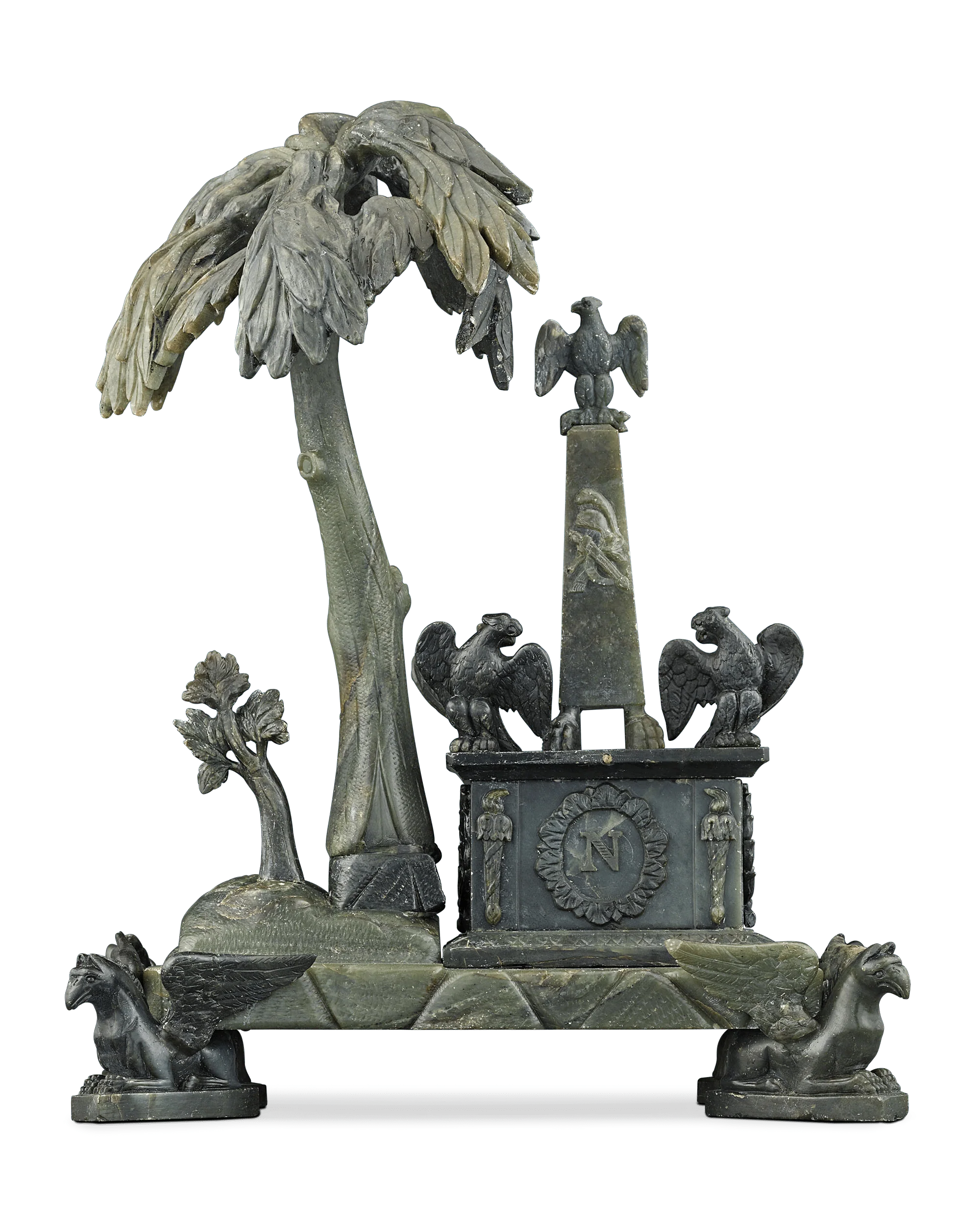
Skillfully crafted of carved nephrite, this one-of-a-kind sculpture is a fantastical recreation of the tomb of Napoléon on St. Helena, the island of the Emperor’s final exile and eventual death. Almost certainly made in the first years following the legendary leader’s death, the work lends Napoléon’s tomb a grandeur and opulence it never achieved in life; the original tomb in St. Helena’s Sane Valley was a simple, unadorned plot beneath a willow. The present piece, however, is crafted with a complexity and majesty befitting the French leader. Fascinating in subject and design, this objet d’art is an intricate and dazzling display of nephrite workmanship.
An island 1,162 miles from the west coast of Africa, St. Helena was chosen as the place of Napoléon’s final exile precisely for its isolation; the British feared a repeat of Elba, when Napoleon escaped exile after just 11 months. Due to its remoteness, few Frenchmen were able to visit the tomb of their former Emperor, and only a handful of sketches of his resting place beneath a willow tree were brought back to France.
In the present piece, the artist carves from a stunning specimen of nephrite his vision of Napoléon’s final resting place. Here, Napoléon’s tomb is bedecked in the adornments of the Empire style, with a French Imperial eagle at each corner. The top of the tomb can be removed, revealing a tiny Napoléon figurine carved from nephrite, complete with his distinctive bicorne hat, resting inside. The tomb rests beneath the flowing limbs of a St. Helena willow tree, which is the one true-to-life element of this stunning and imaginative rendering.
Napoléon's exile to St. Helena in 1815 brought an end to the Napoleonic Wars that had dominated the preceding years. After his death in 1821, his body would spend another 19 years on the island in an unnamed tomb surrounded by a simple railing. Among the visitors to Napoléon’s grave was the English naturalist Charles Darwin. With regards to the gravesite, he wrote: "…a tomb situated close by cottages and a frequented road does not create feelings in unison with the imagined resting place of so great a spirit… if Napoléon's ghost haunts his dreary place of confinement, this would be a most excellent night for such wandering Spirits."
Like Darwin, the craftsman of this extraordinary piece must have balked at the simplified resting place of the once-great leader. Yet, Napoléon would eventually find a more suitable burial place - in 1840, following a request from the King Louis-Philippe, Napoléon’s remains were returned to Paris, where they were entombed in the Dôme des Invalides.
Circa 1830
19 1/4" high x 15 1/2" wide x 9" deep
An island 1,162 miles from the west coast of Africa, St. Helena was chosen as the place of Napoléon’s final exile precisely for its isolation; the British feared a repeat of Elba, when Napoleon escaped exile after just 11 months. Due to its remoteness, few Frenchmen were able to visit the tomb of their former Emperor, and only a handful of sketches of his resting place beneath a willow tree were brought back to France.
In the present piece, the artist carves from a stunning specimen of nephrite his vision of Napoléon’s final resting place. Here, Napoléon’s tomb is bedecked in the adornments of the Empire style, with a French Imperial eagle at each corner. The top of the tomb can be removed, revealing a tiny Napoléon figurine carved from nephrite, complete with his distinctive bicorne hat, resting inside. The tomb rests beneath the flowing limbs of a St. Helena willow tree, which is the one true-to-life element of this stunning and imaginative rendering.
Napoléon's exile to St. Helena in 1815 brought an end to the Napoleonic Wars that had dominated the preceding years. After his death in 1821, his body would spend another 19 years on the island in an unnamed tomb surrounded by a simple railing. Among the visitors to Napoléon’s grave was the English naturalist Charles Darwin. With regards to the gravesite, he wrote: "…a tomb situated close by cottages and a frequented road does not create feelings in unison with the imagined resting place of so great a spirit… if Napoléon's ghost haunts his dreary place of confinement, this would be a most excellent night for such wandering Spirits."
Like Darwin, the craftsman of this extraordinary piece must have balked at the simplified resting place of the once-great leader. Yet, Napoléon would eventually find a more suitable burial place - in 1840, following a request from the King Louis-Philippe, Napoléon’s remains were returned to Paris, where they were entombed in the Dôme des Invalides.
Circa 1830
19 1/4" high x 15 1/2" wide x 9" deep
Skillfully crafted of carved nephrite, this one-of-a-kind sculpture is a fantastical recreation of the tomb of Napoléon on St. Helena, the island of the Emperor’s final exile and eventual death. Almost certainly made in the first years following the legendary leader’s death, the work lends Napoléon’s tomb a grandeur and opulence it never achieved in life; the original tomb in St. Helena’s Sane Valley was a simple, unadorned plot beneath a willow. The present piece, however, is crafted with a complexity and majesty befitting the French leader. Fascinating in subject and design, this objet d’art is an intricate and dazzling display of nephrite workmanship.
An island 1,162 miles from the west coast of Africa, St. Helena was chosen as the place of Napoléon’s final exile precisely for its isolation; the British feared a repeat of Elba, when Napoleon escaped exile after just 11 months. Due to its remoteness, few Frenchmen were able to visit the tomb of their former Emperor, and only a handful of sketches of his resting place beneath a willow tree were brought back to France.
In the present piece, the artist carves from a stunning specimen of nephrite his vision of Napoléon’s final resting place. Here, Napoléon’s tomb is bedecked in the adornments of the Empire style, with a French Imperial eagle at each corner. The top of the tomb can be removed, revealing a tiny Napoléon figurine carved from nephrite, complete with his distinctive bicorne hat, resting inside. The tomb rests beneath the flowing limbs of a St. Helena willow tree, which is the one true-to-life element of this stunning and imaginative rendering.
Napoléon's exile to St. Helena in 1815 brought an end to the Napoleonic Wars that had dominated the preceding years. After his death in 1821, his body would spend another 19 years on the island in an unnamed tomb surrounded by a simple railing. Among the visitors to Napoléon’s grave was the English naturalist Charles Darwin. With regards to the gravesite, he wrote: "…a tomb situated close by cottages and a frequented road does not create feelings in unison with the imagined resting place of so great a spirit… if Napoléon's ghost haunts his dreary place of confinement, this would be a most excellent night for such wandering Spirits."
Like Darwin, the craftsman of this extraordinary piece must have balked at the simplified resting place of the once-great leader. Yet, Napoléon would eventually find a more suitable burial place - in 1840, following a request from the King Louis-Philippe, Napoléon’s remains were returned to Paris, where they were entombed in the Dôme des Invalides.
Circa 1830
19 1/4" high x 15 1/2" wide x 9" deep
An island 1,162 miles from the west coast of Africa, St. Helena was chosen as the place of Napoléon’s final exile precisely for its isolation; the British feared a repeat of Elba, when Napoleon escaped exile after just 11 months. Due to its remoteness, few Frenchmen were able to visit the tomb of their former Emperor, and only a handful of sketches of his resting place beneath a willow tree were brought back to France.
In the present piece, the artist carves from a stunning specimen of nephrite his vision of Napoléon’s final resting place. Here, Napoléon’s tomb is bedecked in the adornments of the Empire style, with a French Imperial eagle at each corner. The top of the tomb can be removed, revealing a tiny Napoléon figurine carved from nephrite, complete with his distinctive bicorne hat, resting inside. The tomb rests beneath the flowing limbs of a St. Helena willow tree, which is the one true-to-life element of this stunning and imaginative rendering.
Napoléon's exile to St. Helena in 1815 brought an end to the Napoleonic Wars that had dominated the preceding years. After his death in 1821, his body would spend another 19 years on the island in an unnamed tomb surrounded by a simple railing. Among the visitors to Napoléon’s grave was the English naturalist Charles Darwin. With regards to the gravesite, he wrote: "…a tomb situated close by cottages and a frequented road does not create feelings in unison with the imagined resting place of so great a spirit… if Napoléon's ghost haunts his dreary place of confinement, this would be a most excellent night for such wandering Spirits."
Like Darwin, the craftsman of this extraordinary piece must have balked at the simplified resting place of the once-great leader. Yet, Napoléon would eventually find a more suitable burial place - in 1840, following a request from the King Louis-Philippe, Napoléon’s remains were returned to Paris, where they were entombed in the Dôme des Invalides.
Circa 1830
19 1/4" high x 15 1/2" wide x 9" deep
$13,350.00
Original: $44,500.00
-70%Nephrite Napoleonic Tomb Sculpture—
$44,500.00
$13,350.00Description
Skillfully crafted of carved nephrite, this one-of-a-kind sculpture is a fantastical recreation of the tomb of Napoléon on St. Helena, the island of the Emperor’s final exile and eventual death. Almost certainly made in the first years following the legendary leader’s death, the work lends Napoléon’s tomb a grandeur and opulence it never achieved in life; the original tomb in St. Helena’s Sane Valley was a simple, unadorned plot beneath a willow. The present piece, however, is crafted with a complexity and majesty befitting the French leader. Fascinating in subject and design, this objet d’art is an intricate and dazzling display of nephrite workmanship.
An island 1,162 miles from the west coast of Africa, St. Helena was chosen as the place of Napoléon’s final exile precisely for its isolation; the British feared a repeat of Elba, when Napoleon escaped exile after just 11 months. Due to its remoteness, few Frenchmen were able to visit the tomb of their former Emperor, and only a handful of sketches of his resting place beneath a willow tree were brought back to France.
In the present piece, the artist carves from a stunning specimen of nephrite his vision of Napoléon’s final resting place. Here, Napoléon’s tomb is bedecked in the adornments of the Empire style, with a French Imperial eagle at each corner. The top of the tomb can be removed, revealing a tiny Napoléon figurine carved from nephrite, complete with his distinctive bicorne hat, resting inside. The tomb rests beneath the flowing limbs of a St. Helena willow tree, which is the one true-to-life element of this stunning and imaginative rendering.
Napoléon's exile to St. Helena in 1815 brought an end to the Napoleonic Wars that had dominated the preceding years. After his death in 1821, his body would spend another 19 years on the island in an unnamed tomb surrounded by a simple railing. Among the visitors to Napoléon’s grave was the English naturalist Charles Darwin. With regards to the gravesite, he wrote: "…a tomb situated close by cottages and a frequented road does not create feelings in unison with the imagined resting place of so great a spirit… if Napoléon's ghost haunts his dreary place of confinement, this would be a most excellent night for such wandering Spirits."
Like Darwin, the craftsman of this extraordinary piece must have balked at the simplified resting place of the once-great leader. Yet, Napoléon would eventually find a more suitable burial place - in 1840, following a request from the King Louis-Philippe, Napoléon’s remains were returned to Paris, where they were entombed in the Dôme des Invalides.
Circa 1830
19 1/4" high x 15 1/2" wide x 9" deep
An island 1,162 miles from the west coast of Africa, St. Helena was chosen as the place of Napoléon’s final exile precisely for its isolation; the British feared a repeat of Elba, when Napoleon escaped exile after just 11 months. Due to its remoteness, few Frenchmen were able to visit the tomb of their former Emperor, and only a handful of sketches of his resting place beneath a willow tree were brought back to France.
In the present piece, the artist carves from a stunning specimen of nephrite his vision of Napoléon’s final resting place. Here, Napoléon’s tomb is bedecked in the adornments of the Empire style, with a French Imperial eagle at each corner. The top of the tomb can be removed, revealing a tiny Napoléon figurine carved from nephrite, complete with his distinctive bicorne hat, resting inside. The tomb rests beneath the flowing limbs of a St. Helena willow tree, which is the one true-to-life element of this stunning and imaginative rendering.
Napoléon's exile to St. Helena in 1815 brought an end to the Napoleonic Wars that had dominated the preceding years. After his death in 1821, his body would spend another 19 years on the island in an unnamed tomb surrounded by a simple railing. Among the visitors to Napoléon’s grave was the English naturalist Charles Darwin. With regards to the gravesite, he wrote: "…a tomb situated close by cottages and a frequented road does not create feelings in unison with the imagined resting place of so great a spirit… if Napoléon's ghost haunts his dreary place of confinement, this would be a most excellent night for such wandering Spirits."
Like Darwin, the craftsman of this extraordinary piece must have balked at the simplified resting place of the once-great leader. Yet, Napoléon would eventually find a more suitable burial place - in 1840, following a request from the King Louis-Philippe, Napoléon’s remains were returned to Paris, where they were entombed in the Dôme des Invalides.
Circa 1830
19 1/4" high x 15 1/2" wide x 9" deep